
The monument comes first; the festival works around it
Every French outdoor festival has a site manager. At a field in Finistère or on a lake peninsula near Belfort, that person's job is largely logistical: roads, power, drainage, the geometry of how a temporary city assembles and dissolves in a weekend.
At a classified Roman monument — the Théâtre Antique d'Orange in the Vaucluse, or the ancient theatre at Vaison-la-Romaine — the job carries an additional master. The stone was there two thousand years before the festival, and French law, administered through the Architectes des Bâtiments de France, ensures it will be there two thousand years after.
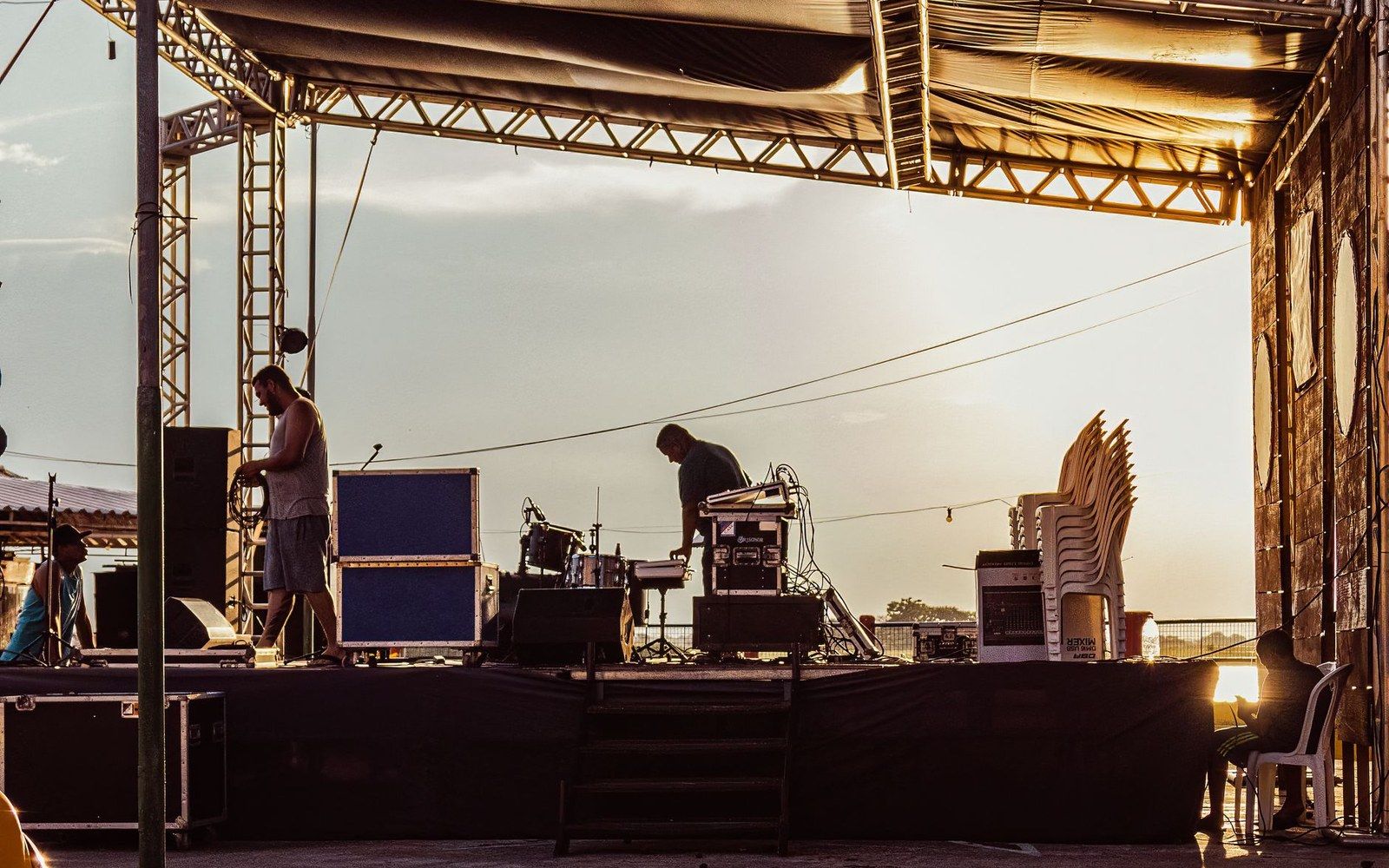
The consequence is concrete and unglamorous: nothing may be drilled, plugged, pinned or chemically fixed into the protected fabric. Not a cable bracket. Not a lighting bar mount. Not a rigging anchor.
Every crew member who arrives on site to build a show must work as if the monument is made of something infinitely more fragile than it looks — which, in conservation terms, it is. Roman cut stone is classified under the monuments historiques framework, and any intervention that damages or degrades the fabric constitutes a criminal offence under French heritage law, not merely a contractual breach.
How the constraints stack
- monuments historiques
- the French classification that triggers full heritage protection; working on classified fabric without authorisation is a criminal matter, not just a contractual one
- Architectes des Bâtiments de France
- the state architects who must approve any intervention on or adjacent to a classified monument
- rigging plot
- a scale drawing specifying every hanging point, its load and its geometry; required before the first truck unloads
- contact zone documentation
- photographic record of every point where a temporary structure meets the monument, taken before rigging and after the get-out
How you rig when you cannot drill
The practical answer is weight and geometry. Where a modern arena might drill a ring bolt into a concrete beam and hang a chain motor from it, a production team at a Roman theatre builds a freestanding structure that leans against or bridges the ancient masonry without penetrating it.
Timber and steel frames are designed to spread load across broad padded contact points; rubber and dense foam interface between metal and stone wherever a surface bears weight. Every contact zone is documented photographically before rigging begins and inspected again on the get-out, the overnight strike after the final performance.
The rigging plot — the technical drawing that specifies every hanging point, its load and its geometry — must be submitted to the monument's custodians and to the Architectes des Bâtiments de France before the first truck arrives. Changes during the build require authorisation. A rigger who improvises a fixing on the day because a truss needs to move half a metre is not solving a problem; they are creating a heritage incident.
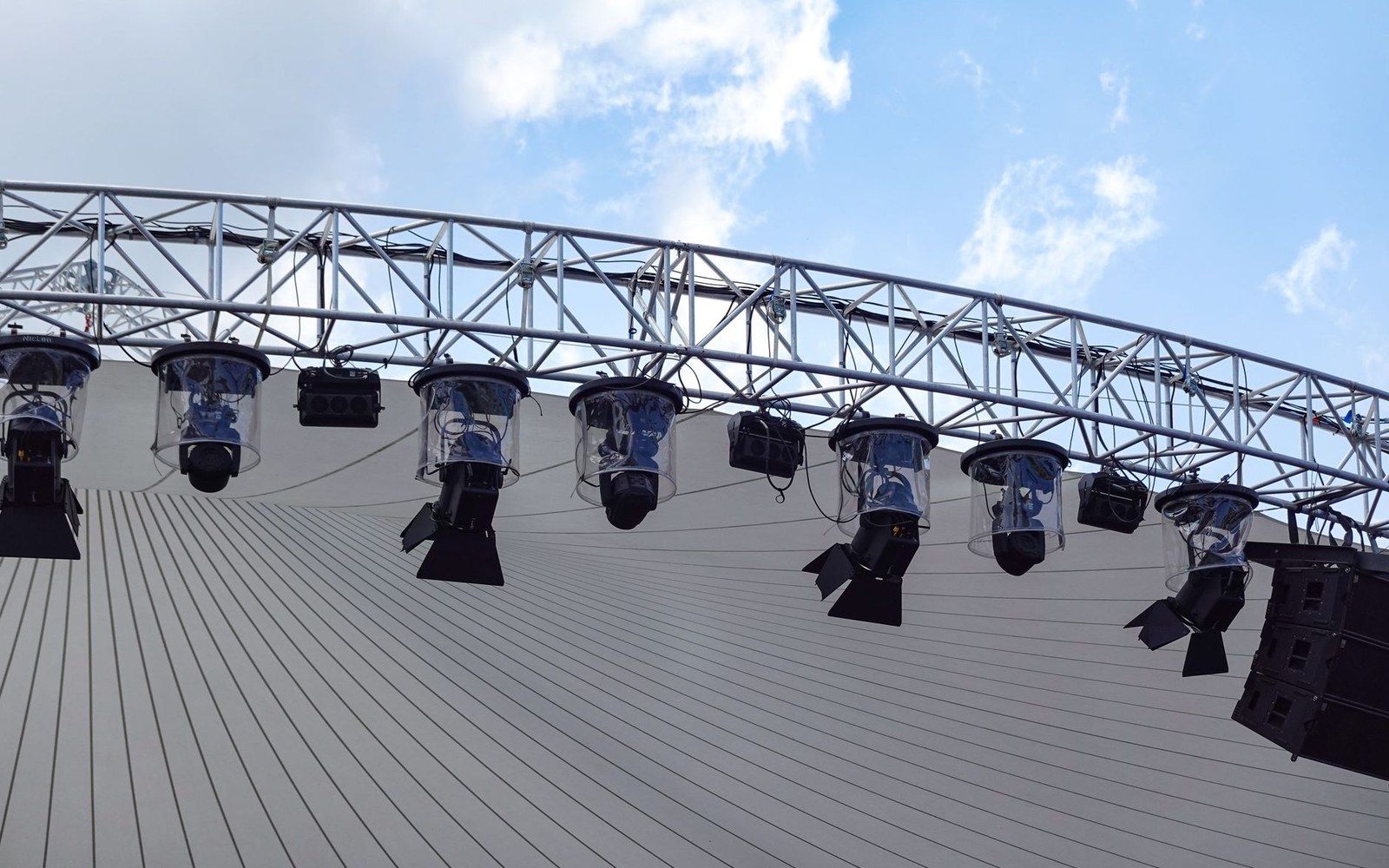
At Orange, the scaenae frons — the great stage wall, 103 metres across — is the surface that defines the acoustic and the spectacle of the Chorégies. It is also the surface that cannot be touched. Lighting positions are arranged on towers and stands that clear the wall entirely; any projection onto it is exactly that, light thrown from a distance rather than a fixture mounted on it.
Stonemasons in the crew
This is where the category of worker that gives the article its name comes in. Large-scale productions at protected monuments often retain a stone conservator — sometimes called a maçon de monuments historiques, a stonemason licensed to work on protected fabric — not to build anything new but to monitor and report.
Their role during a production week is to walk the structure daily, to record any new crack, salt efflorescence or surface spall that appears, and to determine whether any observed change predates the production or was caused by it.
That last determination matters enormously: festival organisers are liable for damage they cause, but they are not liable for deterioration that was already in progress. The stonemason's log is the legal and technical evidence that separates the two.
The stonemason's log is the legal and technical evidence that separates the two.
After the event, the same conservator may carry out small reversible interventions — re-pointing a joint that vibration has loosened, consolidating a flake that was already detaching — using lime mortars and techniques consistent with the original construction. No Portland cement, no epoxy, no synthetic consolidants that would trap moisture or expand at a different rate from the host material.
Who is in the room
- maçon de monuments historiques
- a stonemason licensed under the French heritage framework to work on protected fabric; present during a production week to monitor, not to build
- rigger
- responsible for all hanging loads; at a monument, their work is constrained by a pre-approved rigging plot they may not improvise around
- Architectes des Bâtiments de France
- Architectes des Bâtiments de France: state architects embedded in each département, whose sign-off governs any physical intervention on classified sites
The festival audience, watching a performance under the same sky that Roman spectators watched under, tends not to think about any of this. The stone simply looks permanent. Behind that appearance of permanence is a negotiated, documented, annually renewed contract between the people who make the show and the people whose job it is to ensure that the show, however spectacular, leaves no trace.