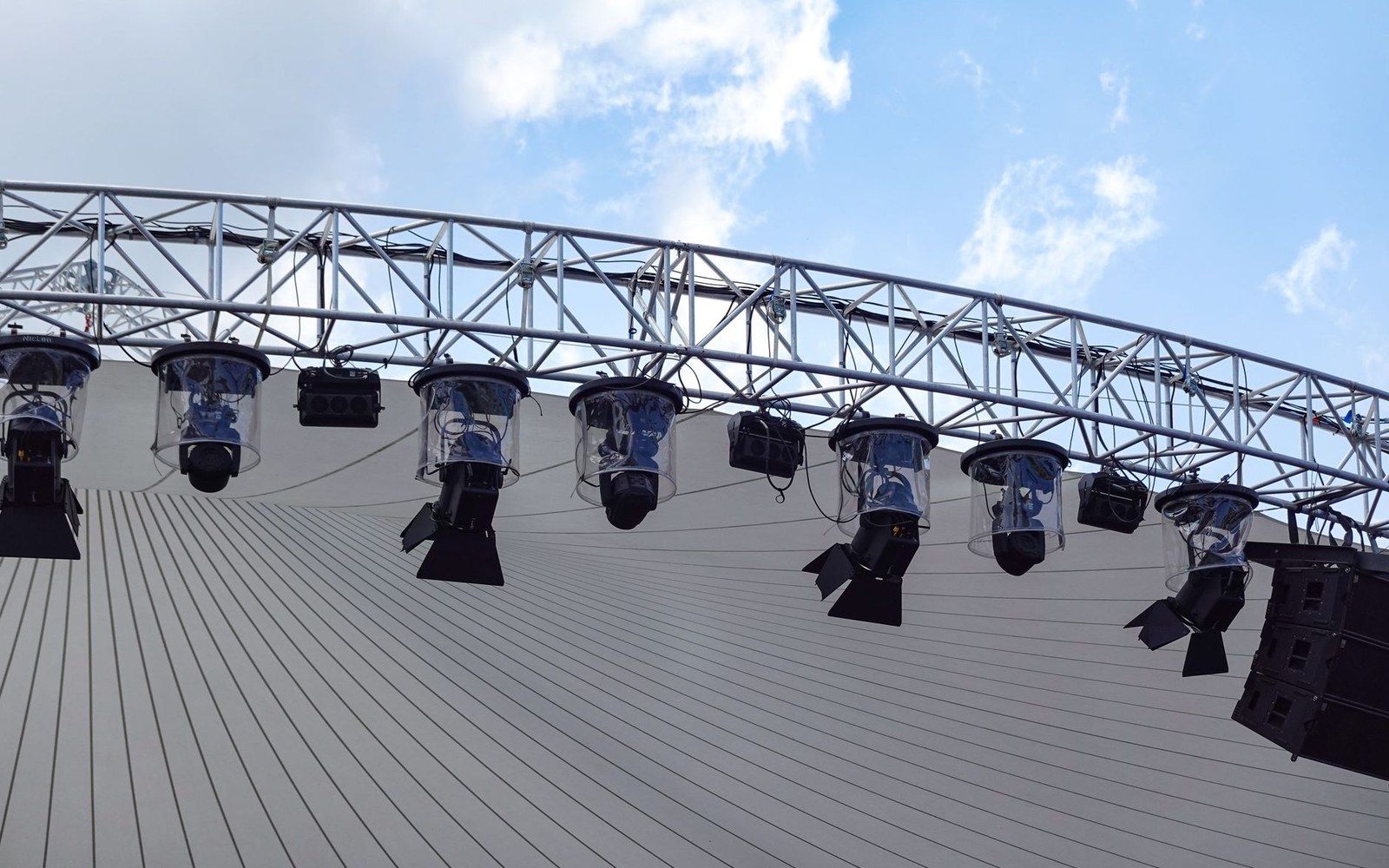
The people overhead whom the audience never sees
Every speaker cluster, every lighting bar, every drape and truss that hangs above a stage got there because a rigger calculated whether it could, and then climbed to put it there. Rigging is the discipline of suspending weight from structures not built for the purpose — Roman stonework, temporary scaffolding, steel grid — and it sits at the intersection of physics, building law and professional nerve.
In a purpose-built venue, the answer to whether a point can take the load lives in engineering drawings. At a historic monument — the Théâtre Antique d'Orange in the commune of Orange, or the courtyard of the Palais des Papes in Avignon — there may be no such drawing, or none that anticipates a modern production rig. Before a single motor goes up, a structural survey is commissioned.

A consulting engineer assesses the stone, the mortar, the hidden voids, and issues a loading limit per fixing point. That document is the rigger's licence to proceed and their legal cover if anything is later disputed.
What a rigging plot actually says
The rigging plot is the production's structural drawing: every hanging point, every motor or deadweight, every load expressed in kilogrammes, every angle of bridle (the V-shaped sling used when a single drop point serves two attachment legs).
Angles matter because a bridle at sixty degrees from vertical roughly doubles the tension in each leg; at wider angles the multiplier climbs steeply. A rigger reading a plot is not just following a map — they are checking the arithmetic and pushing back when a designer's geometry has quietly created a load that the venue cannot absorb.
At a temporary outdoor stage, the structure itself is engineered as part of the event. Roof systems for large festivals — the kind used at Les Eurockéennes on the presqu'île du Malsaucy near Belfort, or across the farmland stages at Carhaix-Plouguer — are supplied by specialist companies and come with their own load schedules and certified attachment points.
Vocabulary in this piece
- rigging plot
- production drawing showing every hanging point, load in kilogrammes and bridle geometry
- bridle
- a V-shaped sling running from two attachment legs to a single drop point; angle determines tension multiplier
- travaux en hauteur
- French regulatory category for work at height; governs certification and insurance
- safety bond
- secondary line attached to a suspended load to catch it if the primary fixing fails
- chain hoist
- manually or electrically operated device used to lift and position a suspended load to a precise height
The rigger works within those schedules, distributing the weight of line arrays and delay speakers, lighting trusses and video panels across a finite number of rated points. When the design team adds one more element late in the build, it is the rigger who tells them whether the budget of load has run out.
The sign-off before anyone sings
Rigging is one of the few festival disciplines with a formal competency structure. In France, work on suspended loads above an audience falls under the general regime of travaux en hauteur — work at height — and the relevant European standards for manually operated chain hoists (EN 818 for chain slings, EN 13157 for hand-operated equipment) govern what equipment may be used and how it must be inspected.
Work on rigging points and suspended loads in performance venues sits under further certification. A rigger is not a category that exists informally; at the professional level it carries documented training, insurance and a paper trail.
The sign-off itself — the moment the head rigger declares the rig safe to use — typically happens in the hours before doors open, after a final check of all chain-hoist positions, motor loads and safety bonds (secondary lines that catch a load if a primary fitting fails).

Nothing is assumed to be the same as last night or last year. Temperatures change the behaviour of steel; a gust of wind — and at an open-air site in Provence, the mistral is a calculated risk, not a surprise — can introduce dynamic loading that static calculations do not capture. Bonds exist precisely because dynamic loads are real.
What the audience sees is the result: a speaker cluster at the correct height and angle, a lighting rig that puts colour on the performer's face rather than their feet, a stage picture that looks effortless because the geometry was resolved before the show began.
At a temporary outdoor stage, the structure itself is engineered as part of the event.
What they do not see is the person who climbed to the top of the structure in the dark of the load-in, clipped on, and worked through a plot point by point until every number matched. The rigger is absent from the credits on the ticket. They are present in the fact that nothing fell.
Where the numbers come from
- EN 818 (chain slings) and EN 13157 (hand-operated lifting equipment)
- the European standards that define what rigging equipment may be used above an audience
- A structural engineer's loading survey
- required before any fixing into historic stone; sets the per-point weight limit the rigger works within