The Roman theatre at Vaison, and what survives elsewhere
The Théâtre Antique at Vaison-la-Romaine, in the Vaucluse, retains its cavea — the tiered semicircle of stone seats — in notably good condition, having benefited from systematic excavation and consolidation through the twentieth century. What it lacks is the scaenae frons, the tall stage wall that once closed the performance space behind the actors.
That wall is gone, reduced to foundations, leaving the stage open to a wide Provençal sky and the hills beyond. The acoustic consequence is direct: without a vertical surface to return early reflections toward the audience, unamplified sound disperses rather than projects, and the theatre's use as a performance venue depends heavily on amplification.
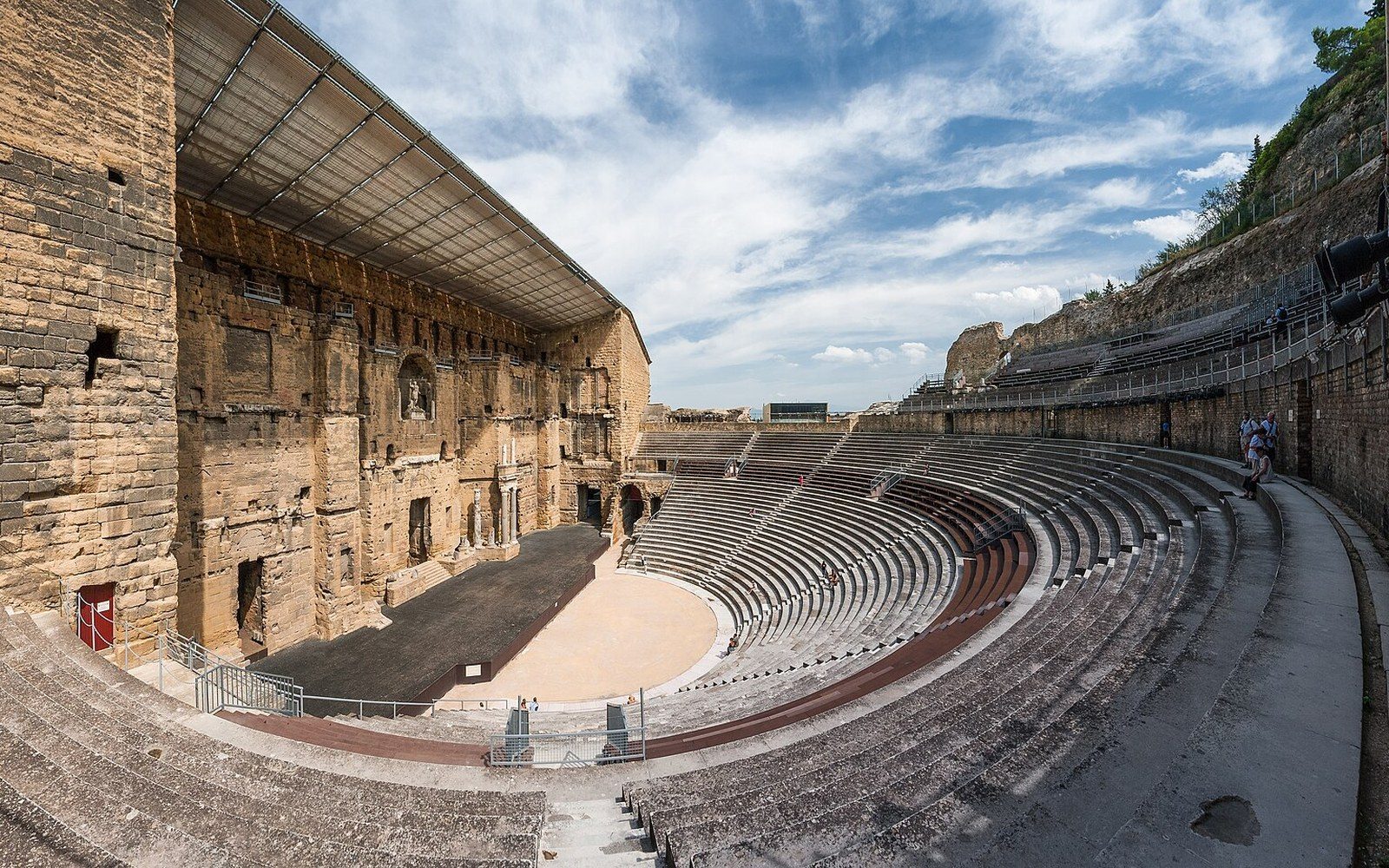
Orange, some twenty-five kilometres to the southwest, is the counter-example. Its stage wall stands to nearly its original height, and the Chorégies d'Orange have built their summer opera season around that acoustic fact since the nineteenth century. The wall does what a scaenae frons does — it returns sound, concentrates it, and frames the stage as an interior even under open sky.
Several smaller Roman theatre sites survive across Provence and the wider south. Arles, in the Bouches-du-Rhône, retains two standing columns from its scaenae frons — what locals call the "deux veuves," the two widows — and little else of the original structure above ground.
Vienne, further north in the Rhône valley, preserves its cavea well and hosts Jazz à Vienne in the summer; its stage wall is partly reconstructed. None of these approaches Orange's completeness.
What each site keeps
- Vaison-la-Romaine (Vaucluse)
- cavea largely intact; scaenae frons gone to foundations
- Orange (Vaucluse)
- stage wall standing near original height; cavea restored
- Arles (Bouches-du-Rhône)
- two columns of scaenae frons survive ("deux veuves"); cavea largely lost
- Vienne (Isère)
- cavea well-preserved; stage wall partly reconstructed
The pattern across all of them is the same erasure in the same order: the portable stonework of the stage building was quarried away for medieval construction first, the cavea seats later. What survives at any site reflects how vigorously its stone was wanted elsewhere, and how soon the site attracted enough scholarly attention to be protected. At Vaison, the seats were worth saving. The wall was already gone.