The Room That Was Never Designed for Performance
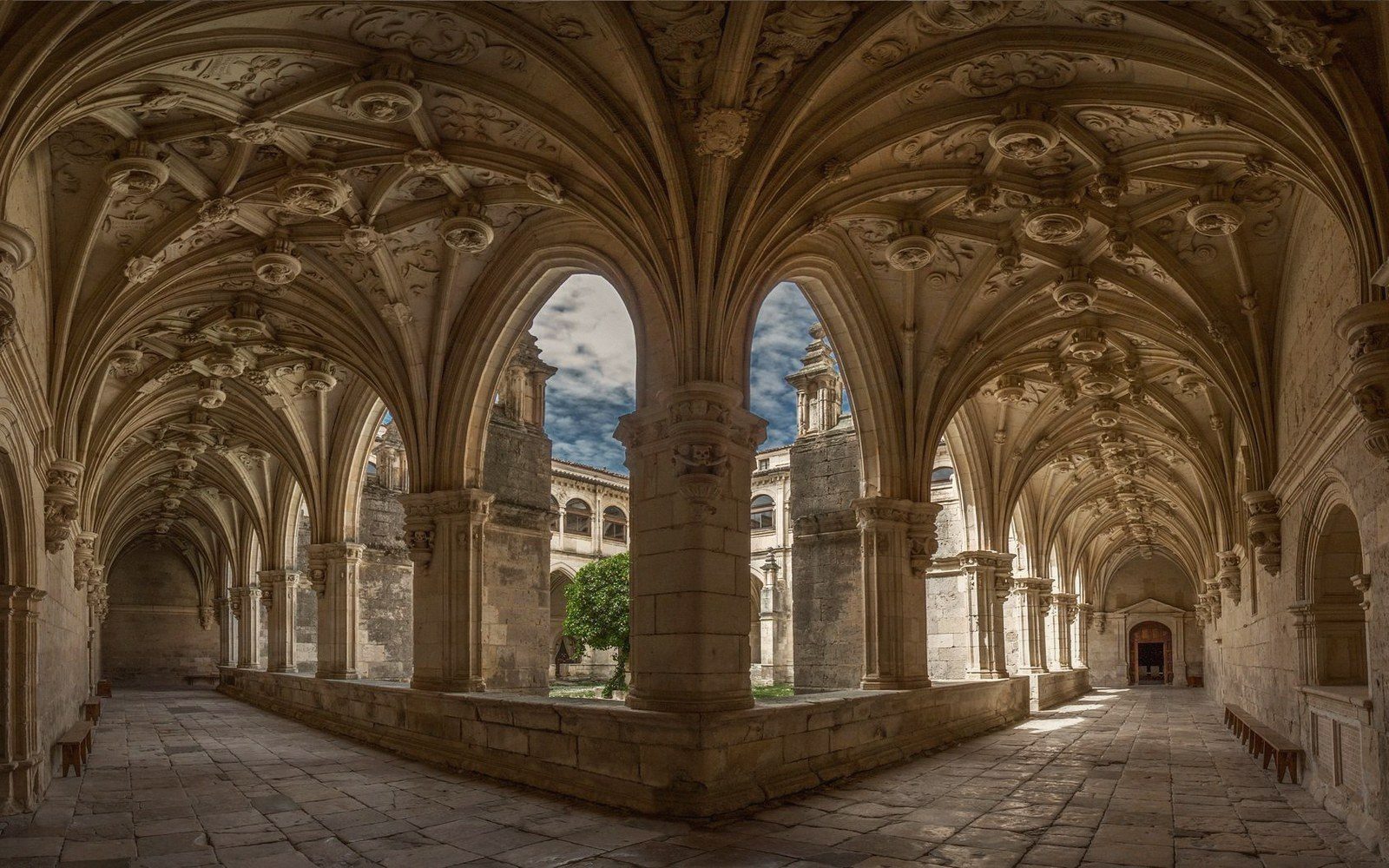
A cloister is a circulation space. The canonical form — four covered walkways around an open garth, each walkway vaulted or arcaded in stone — was built for a daily round of movement between church, chapter house, refectory and dormitory.
Every surface is hard: cut stone underfoot, stone columns, stone vaulting, the church wall rising on one side. The open sky sits above the garth but the covered walks are essentially a shallow stone box on four sides, and that geometry creates a reverberation time measured in seconds rather than milliseconds.
That long tail is not neutral. It suits certain repertoire precisely because it was not designed to suit any repertoire at all. A plainchant procession sounds magnificent in a cloister for the same reason it sounds magnificent in a Romanesque nave: the room adds a shimmer of late energy that the unamplified single line can carry without confusion.
But pile in harmonic density — a string quartet playing fast counterpoint, a wind ensemble with overlapping entries — and those late reflections blur the attack into mush. The cloister imposes repertoire on the programmer whether the programmer likes it or not.
The acoustic trade-off
- Reverberation time
- the duration in seconds that sound persists after the source stops; long in stone cloisters
- Clarity
- the ratio of early to late sound energy; falls as reverberation time rises
- Envelopment
- the subjective sense of being surrounded by sound, strongest when lateral reflections arrive from multiple directions simultaneously
- Absorption coefficient
- a material property measuring how much sound energy a surface absorbs; very low for cut stone
What the Arcade Does to Sound
The covered walkways act as a lateral reflector on all four sides simultaneously. Sound from an ensemble placed in the garth, or against one wall, bounces off the stone floor of the opposite walk, off the vaulted ceiling of the near walk, off every column shaft in the arcade.
There is no single dominant reflection — the room is nearly symmetrical — so the listener receives a wash of energy from multiple directions, which the ear reads as envelopment rather than echo. That envelopment is why chamber music in cloisters can feel physically immersive, a quality concert halls spend considerable engineering effort trying to recreate.
The catch is clarity. Reverberation time and clarity trade against each other directly: a room that holds energy long gives every note a halo, and when notes arrive faster than the room can clear, they pile up.
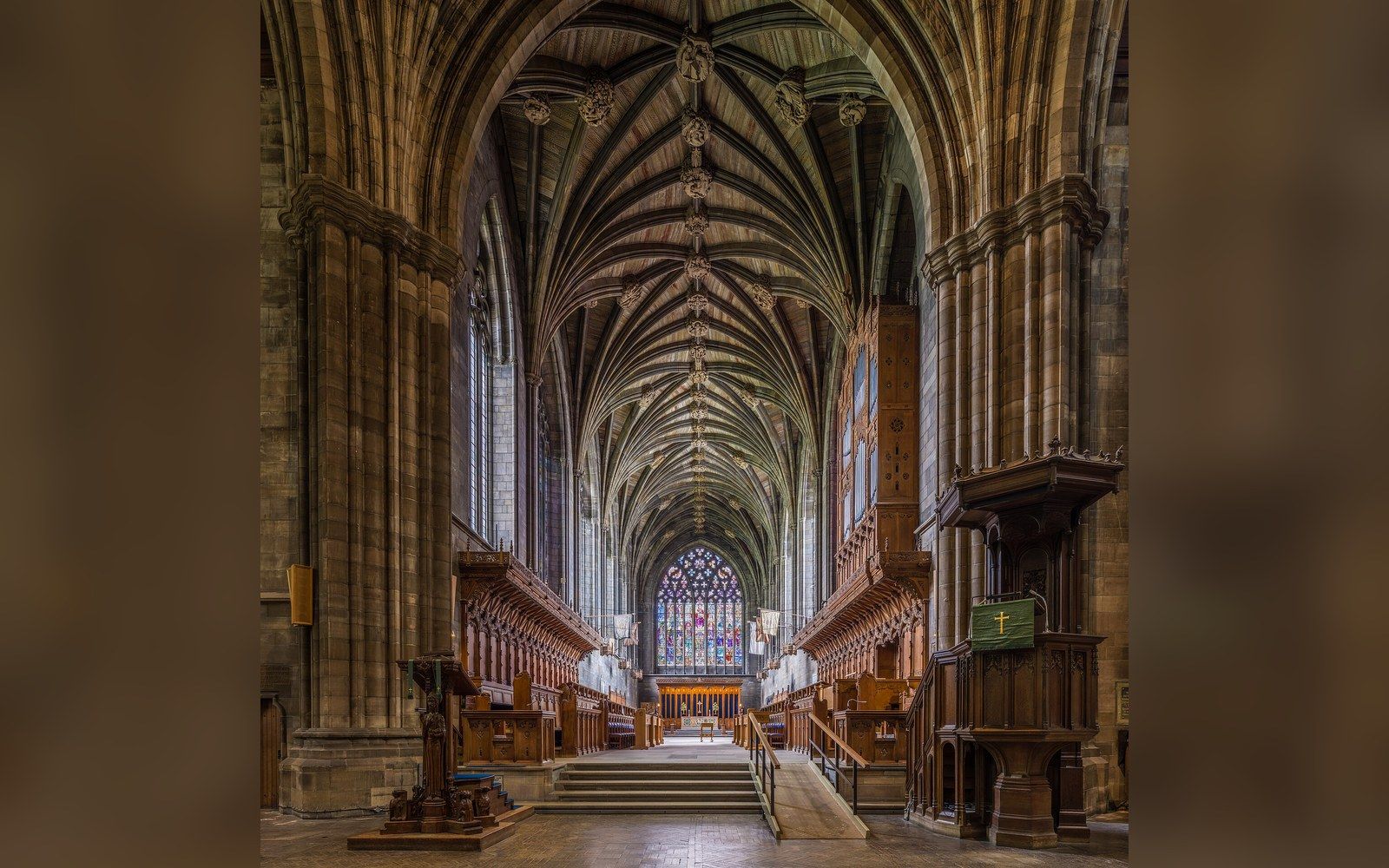
Baroque and Renaissance vocal polyphony, written when stone rooms were the assumed acoustic environment, tolerates this — was written, in fact, with this tolerance built in. Romantic piano trios and twentieth-century chamber music were not. A festival that books both in the same cloister will hear one programme glow and the other swim.
Choosing a Cloister
The decision to use a cloister as a performance space is partly acoustic, partly about the visual and ceremonial weight the space lends the event, and partly practical.
A cloister is enclosed and enclosed means controllable: a finite audience capacity, a defined perimeter, shelter from the mistral or evening rain under the walkway roofs. It does not need a stage structure to define the performing area — the garth does that already, and the arcades provide seated galleries on all four sides if needed.
Festival d'Aix-en-Provence has used cloistered spaces as well as the better-known Cour de l'Archevêché, exploiting the Bouches-du-Rhône's density of medieval ecclesiastical buildings.
That envelopment is why chamber music in cloisters can feel physically immersive, a quality concert halls spend considerable engineering effort trying to recreate.
The Romanesque and Gothic cloisters attached to abbeys and cathedrals across Provence and the Languedoc offer markedly different reverberant profiles depending on their age: Romanesque arches over a shallow garth produce a shorter, more diffuse tail than a high Gothic cloister with a deep vaulted ambulatory. A producer choosing between them is, whether they articulate it this way or not, choosing between two different instruments.
Repertoire and the room
- Medieval plainchant and procession music
- written for stone rooms; benefits from long reverberation
- Baroque polyphony
- tolerates long reverberation; was composed in acoustically similar environments
- Classical-era chamber music and later
- depends on clarity of attack; suffers in rooms with reverberation times above roughly 1.5–2 seconds
What nobody chooses is silence. Stone as a material has very low acoustic absorption across the frequency range, which means the room does not quiet down between pieces. The ambient return — bird sound, traffic, the creak of a chair on stone — arrives wrapped in the same reverberation as the music. In a cloister, the room is always playing along.